


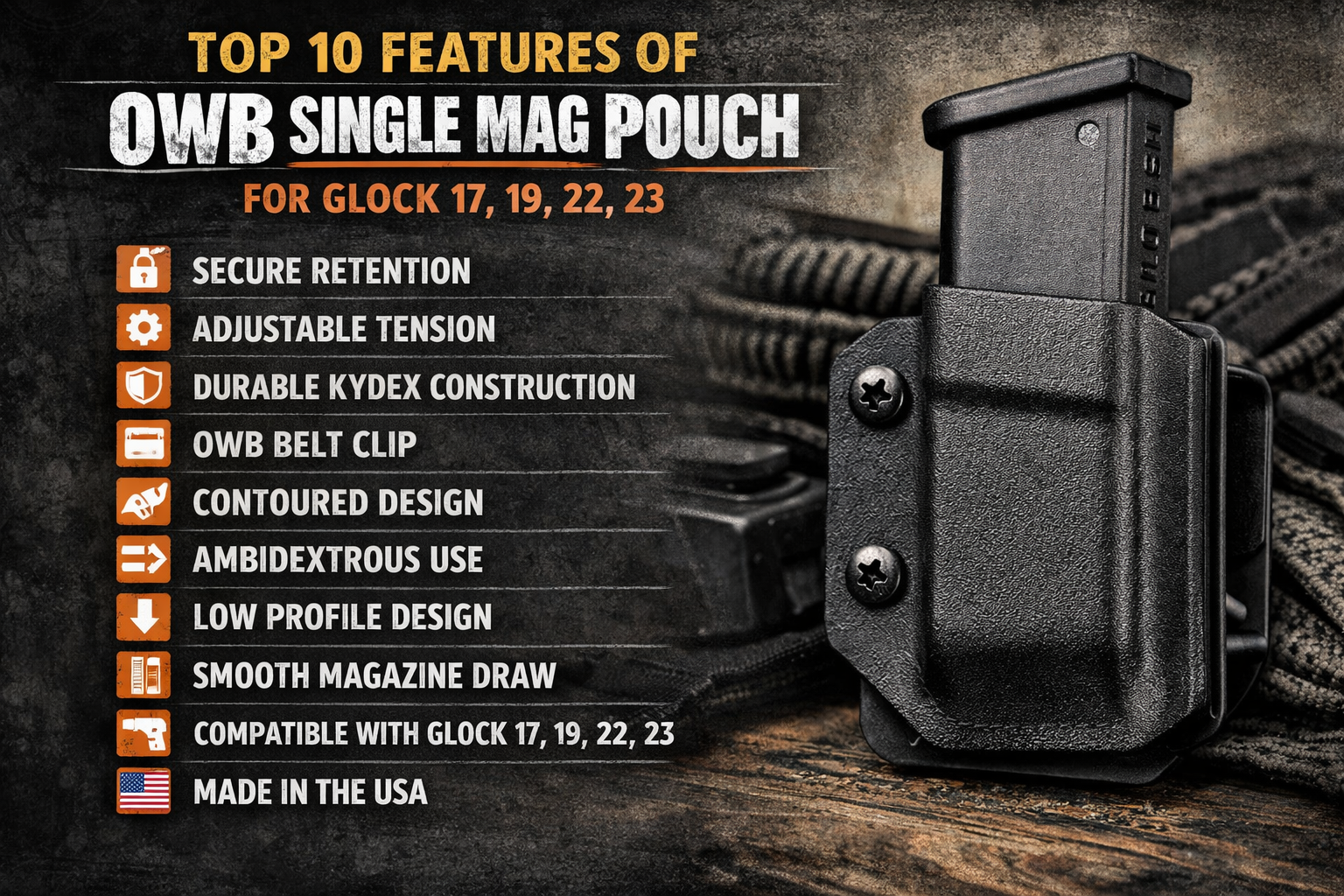
Let’s talk about OWB single mag pouches for Glocks. Specifically, the 17, 19, 22, and 23 the workhorse double-stacks that most of us are running. It might seem like a pretty simple piece of gear, right? Just a little holder for a spare magazine.
But honestly, there’s a surprising amount of nuance if you want something that actually works well and doesn’t just hang there like a useless lump. I’ve been through my fair share of these things over the years, from cheap nylon to fancy custom jobs.
What I’ve learned is that while many companies *say* they offer the “best,” what “best” means to you really depends on what you’re doing with it. Is it for the range? Competition? Or are you one of those folks who carries a spare mag even if it’s outside the waistband?
Getting a Grip on Retention First off, retention is paramount.
It absolutely has to hold that magazine securely. I’ve seen mags tumble out during a quick sprint, or even just getting in and out of a car. It’s annoying at the range, and a major problem if you’re relying on that spare. Most OWB pouches for Glocks use some form of passive retention. That means friction. Good ones will give you a satisfying “click” when you seat the mag. You want it firm enough that it won’t just fall out, but not so tight you have to wrestle with it. Adjustable retention, usually with a screw that lets you tweak the pressure, is a huge plus.
My personal preference leans towards Kydex pouches with adjustable tension. They just seem to hit that sweet spot of secure yet accessible better than most others. Some of the older nylon pouches with elastic bands were okay, but they always felt a bit squishy, and the elastic wears out.
Material Matters Usually Kydex Speaking of Kydex
it’s pretty much the go-to for a reason. It’s rigid, durable, and holds its shape. That means a consistent draw stroke every time. I remember a time when everything was nylon or leather, and while those have a certain appeal, especially for concealment, for OWB, Kydex is just more practical. It sheds dirt, doesn’t absorb sweat like nylon can, and it keeps that magazine exactly where you left it.
Plus, it’s molded specifically for those Glock magazines, so you get that precise fit. I’ve had a few instances where I tried hybrid designs, usually Kydex outer with some soft backing. Honestly, they were often more trouble than they were worth. The idea was comfort, but for an OWB mag pouch, it’s not really rubbing against you much anyway.
You may also Like- Where to buy OWB Double Mag Pouch for Glock 20, 21, 29, 30, 40, 41, H&K USP?
ure Kydex is generally fine. You’ll see Kydex dominating the market now, and for good reason. A quick look at any major gear retailer shows Kydex making up a huge chunk of sales for mag carriers, often exceeding 70% in many categories.
How It Attaches to Your Belt This is a big one.
A good mag pouch is useless if it’s flopping around on your belt. Most OWB pouches use either solid belt loops, a paddle, or sometimes a universal clip. Solid belt loops, typically made from Kydex or a sturdy polymer, are my favorite for pure stability.
They thread onto your belt and lock everything down. The downside is you have to take your belt off to put them on or take them off, which can be a minor annoyance if you’re constantly changing gear. But for a dedicated range setup or something you’re wearing for hours, they’re unbeatable. Paddles are super convenient. They clip over your belt and generally allow for quick on-and-off. The trade-off is often stability.
Some cheaper paddles can feel a bit loose or wobble, especially with a heavier, fully loaded Glock mag. If you go paddle, make sure it’s a well-designed one that really grips the belt and doesn’t allow for much movement. Then you have things like malice clips for MOLLE setups, which are great if you’re running a plate carrier or a battle belt. But for everyday OWB use, belt loops or a good paddle are usually where it’s at.
Angle and Ride Height
This might seem nitpicky, but the angle and ride height of your mag pouch can make a real difference in how smoothly you perform reloads. Most pouches are designed for a vertical draw, which is fine.
Some offer a slight forward cant, which can sometimes make the draw feel a bit more natural, particularly if you’re reaching across your body. Ride height is about how high or low the mag sits on your belt. I prefer a medium ride height not so high it digs into my ribs when I bend, but not so low it’s a pain to reach.
Many quality pouches will let you adjust the ride height by moving the belt attachment point up or down. Experiment with this; what feels good on paper might not feel good when you’re actually drawing under a timer or stress.
Durability
No Brainer, Right? It should go without saying, but it doesn’t always. A mag pouch needs to be tough. We’re talking about something that’s going to get bumped, scraped, exposed to the elements, and have magazines shoved in and out of it hundreds, if not thousands, of times.
The Kydex shouldn’t crack, the hardware (screws, washers) shouldn’t strip or rust, and any belt attachments need to be bomb-proof. I’ve had a few cheap pouches where the screws started backing out after a few range trips, or the Kydex developed hairline cracks around the belt attachment points.
It’s frustrating and ends up costing you more in the long run when you have to replace it. Spend a little more upfront on something from a reputable brand; it pays off.
Open vs. Closed
Top Most modern OWB mag pouches are open-top, meaning no flap covering the magazine. This is pretty much standard for speed and accessibility, whether you’re at the range or carrying defensively.
I honestly can’t remember the last time I willingly used a closed-top mag pouch for anything other than specific field applications where debris was a serious concern.
For Glock magazines, especially the robust factory ones, an open-top design is generally problem-free. You’re not exactly trekking through dense jungle every day with it, right?
Why Carry a Spare Mag OWB?
Okay, so who uses an OWB single mag pouch? A lot of people. Competition shooters are the obvious answer they need quick access to fresh mags. But also folks who train regularly, or even those who carry a firearm OWB and want that extra capacity.
The old adage about needing a spare mag for malfunctions, not just capacity, is still very true. While statistics from agencies like the FBI generally indicate a low number of rounds expended in self-defense scenarios, often under three, carrying a spare mag is more about managing potential stoppages than just raw round count.
A good mag pouch makes those remedial actions much faster. It’s just a sensible addition to a range belt or a duty setup. For concealed carry, most people opt for IWB mag pouches, for obvious reasons. But for OWB, the convenience and speed of access for a single spare mag are hard to beat.
The Little Things
Indexing and Smooth Edges You want a mag pouch that allows for a smooth, consistent draw. That means it should let you grab the magazine in a way that allows you to index it correctly for a reload without fumbling.
Some pouches have a slight flare at the opening, which can help guide the magazine back in cleanly, especially useful during drills. Also, check for smooth edges. Cheap Kydex pouches can sometimes have sharp spots that chafe your skin or fray your clothes over time.
A good manufacturer takes the time to finish the edges properly. It’s a small detail, but it speaks volumes about the overall quality and attention to detail.
Price vs. Value
You can find single OWB mag pouches for Glocks from $15 to $75+. As with most gear, you often get what you pay for. The $15 nylon pouch might hold a mag, but it probably won’t hold it well for long.
Spending $40-$60 on a quality Kydex or injection-molded polymer pouch from a reputable brand like Safariland, Comp-Tac, or Bravo Concealment is usually money well spent.
You’re paying for the precise molding, adjustable retention, durable hardware, and solid belt attachment options. It’s not about being the most expensive, but getting something that reliably performs its function without you having to think about it.
FAQ Just a Few Thoughts
Q: Can I use a single mag pouch made for a Glock 17 magazine with a Glock 19 magazine?
A: Yeah, generally. The Glock 19 magazine is just shorter than the 17. So, it’ll fit, it just won’t stick out as far from the bottom of the pouch. Same goes for the .40 S&W equivalents, the 22 and 23. They’re all pretty much the same width and thickness.
Q: Is OWB really good for everyday carry with a mag pouch?
A: For most folks, if you’re talking about *concealed* everyday carry, an OWB mag pouch is going to be pretty difficult to conceal. It prints pretty easily. For open carry, or competition, or range use, absolutely. But for discreet carry, you’d usually look at IWB options.
Q: How do I know if the retention is too tight or too loose?
A: Best way is to just try it. With an unloaded magazine, practice drawing it a few dozen times. If it feels like you’re fighting it, it’s too tight. If the mag feels like it might slide out if you bend over or move quickly, it’s too loose. A good adjustment lets the mag come out with a firm, deliberate pull, but not accidentally.
Q: Kydex or injection-molded polymer? Does it really matter?
A: For OWB mag pouches, honestly, not a ton for most users. Kydex is thermoformed from a flat sheet, which allows for custom contours and sharper lines. Injection molded is… well, molded. Both can be incredibly durable and offer great retention.
Some might argue Kydex offers a slightly more “custom” feel due to the forming process, but functionally, a good quality injection-molded pouch like some from Safariland or Blade-Tech are fantastic.
Just avoid anything that feels cheap and flimsy. So, there you have it. A single mag pouch for your Glock isn’t the most glamorous piece of gear, but getting a good one makes a real difference. Don’t overthink it, but don’t underthink it either. Get something reliable, and then focus on actually using it to train.

