


Introduction
Whether you’re heading out for a full-day hike, commuting for work, or building your first EDC setup —a single thing i.e. how do you pack a backpack makes a very big difference than most people don’t even realise.
You know a poorly packed backpack results in shoulder pain, strain on your spine, slowing down the mobility or accessibility to whatever you need in an emergency, and turns the most required backpack into a daily annoyance. But what if your backpack is packed the right way? It becomes an extension to you and a true friend of yours throughout the use.
In this guide, we’ll break down the most useful and helpful method that professionals, hikers, and the EDC enthusiasts use to pack their backpack efficiently.
Quick Answer
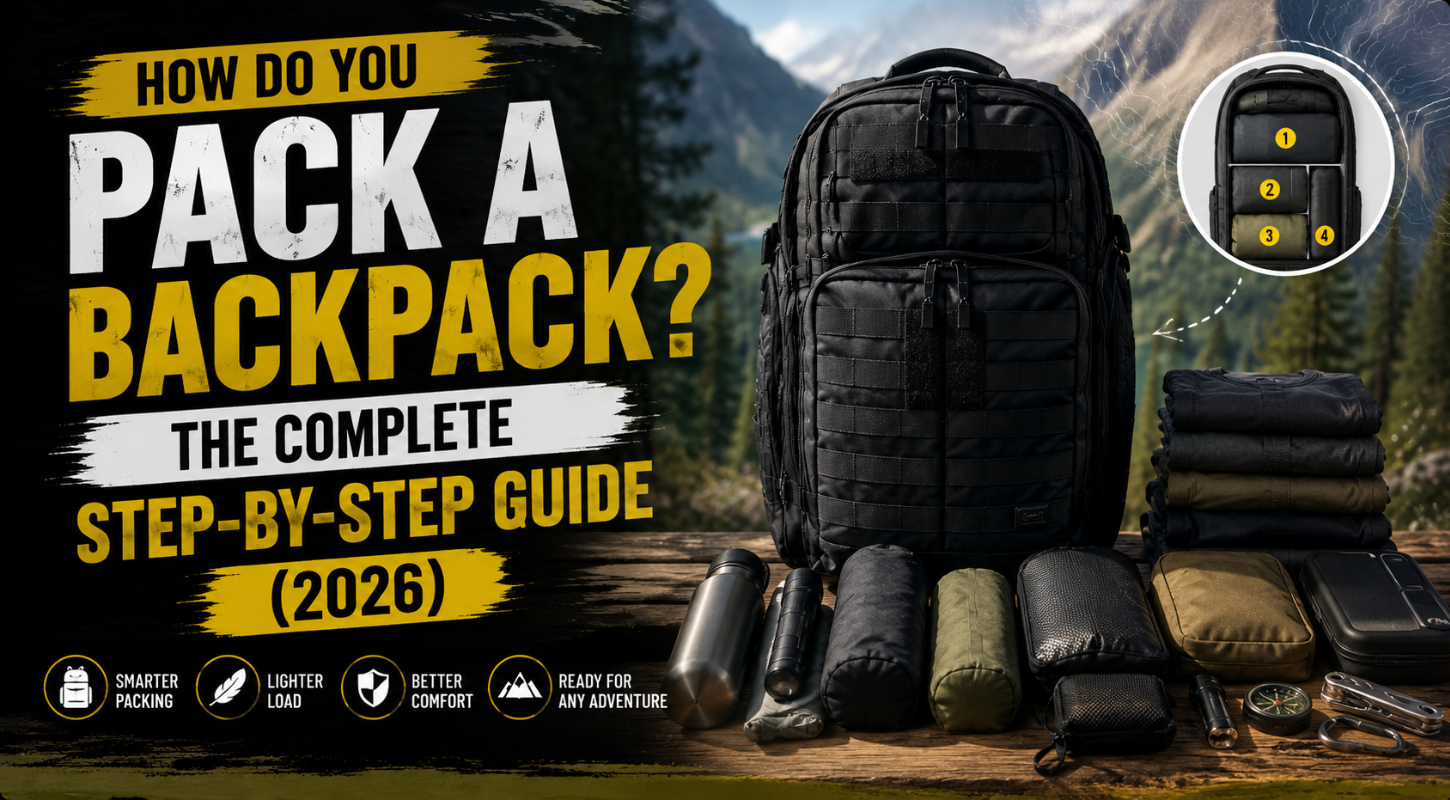
To pack a backpack correctly, start by laying out everything you plan to carry. Place heavier items closest to your back and near the center, medium-weight items in the middle layer, and light or fragile items on top and in outer pockets. Keep frequently used items in easy-reach pockets. This method distributes weight evenly and reduces strain on your back and shoulders.
Why Does Packing Method Actually Matter?
Before jumping into the steps, let’s understand why this matters:
Before directly jumping to the steps and learning how do you pack a backpack, you must first understand why it matters. There are mainly three main reasons that clearly explain why your backpack has to be properly packed:
Weight distribution affects your posture.
A poorly packed backpack doesn’t have a proper weight distribution which later affects your posture and leads to pain.When the heavy items inside sit too slow or too far from the back, your center of gravity shifts backward. At this point, your muscles compensate and lead to neck pain, lower back strain, and fatigue —especially on long carries.
Organization affects speed.
If your water bottle, keys, or wallet are buried under three layers of gear, you’re going to unpack half your bag every time you need them. Strategic packing means everything is exactly where you expect it.
Volume management affects bag life.
Overpacking stretches zippers, strains seams, and deforms the frame. Underpacking lets gear shift and bounce. Getting the balance right extends the life of your bag.
What You Need Before You Start Packing
Before touching your bag, do this:
There are some simple backpack packing tips which help to avoid overloading a backpack with unnecessary items. You must do this before you actually pack your backpack:
- Lay everything out — Dump it all on a flat surface. Bed, floor, table — doesn’t matter. See what you’re actually dealing with.
- Audit ruthlessly — Ask: “Will I actually use this today?” to yourself. If the answer is “maybe,” leave it home and if the answer is “Yes”, then only carry the item with you.
- Group by category — Grouping items helps a lot in both — quick accessibility and carrying the most important gear with you. Tech gear together, documents together, personal items together, frequently used items together, and the emergency items together.
- Check your bag’s layout — Know where your laptop sleeve is, which pockets are quick-access, and where the hydration sleeve is (if any).
Step-by-Step: How Do You Pack a Backpack?
Step 1 — Load the Base (Bottom Zone)
Backpacking starts from the very bottom. Pack here the items that you’re most least likely to use during the day. For example:
- Rain jacket or light fleece (if not needed immediately)
- Extra pair of shoes or sandals
- Packed lunch or snacks you won’t touch until break
- Spare cables and accessories you carry “just in case”
Why: These items act as a foundation. They cushion the bag from below and don’t shift around once other layers are added.
Step 2 — Load the Core (Middle Zone — Closest to Your Back)
This is the most important zone. Everything heavy goes here, pressed against the panel closest to your spine such as:
- Laptop or tablet (use the dedicated sleeve if your bag has one)
- Books, notebooks, or documents
- Water bottle (air tight –no water leakage)
- Power bank or heavy tools
Why: Keeping mass close to your center of gravity reduces the “pulling away” effect that strains your lower back. This is the single most impactful packing decision you can make.
Step 3 — Fill the Middle Layer
Lighter and medium-weight items fill the space around and in front of your core layer:
- Change of clothes or gym gear
- Toiletry bag or personal care kit
- Chargers and cables (in a small pouch)
- Headphones, sunglasses case
Step 4 — Pack the Top Zone for Quick Access
This is the top section of your backpack and must have the items you need quickly and frequently or which you can grab immediately when needed without struggle. Items like:
- Wallet and keys (if not in outer pocket)
- Snacks
- First aid kit
- Transit pass or ID card holder
Step 5 — Use Outer and Side Pockets Strategically
Side pockets: Water bottle, umbrella, tripod — anything you need to pull out and put back fast without opening the main compartment.
Front/admin pocket: This is for your micro-essentials — pens, small notebook, lip balm, earbuds, small multi-tool. If your bag has a dedicated admin panel with loops and slots, use it. If not, a small organizer pouch does the same job.
Hip belt pockets (if available): Snacks, phone, ChapStick — anything you want while in motion without taking the pack off.
How Do You Pack a Backpack for Hiking?
Hiking packing follows the classic three-zone system with extra emphasis on weight distribution and external attachment:
- Bottom zone: Sleeping bag, extra layers, camp shoes
- Core zone (against your back): Tent body, food, bear canister, water reservoir
- Top zone: Rain jacket, first aid, headlamp, snacks
- Hip belt pockets: Phone, trail snacks, lip balm
- External loops/straps: Trekking poles, sleeping pad, wet gear
Keep your headlamp and first aid kit accessible at all times — never bury them.
Read this Guide: Choose the best Hiking Backpack
How Do You Pack a Backpack for EDC (Everyday Carry)?
EDC packing has its own philosophy, and it’s slightly different from hiking or travel packing. The goal isn’t just weight distribution — it’s systematic readiness.
What Is EDC?
EDC means Everyday Carry — Items or the curated set of tools, tech, and the essentials that you need in your everyday carry to handle whatever comes up.
The EDC community takes this seriously, and for good reason: being prepared for daily friction (dead phone, unexpected rain, a loose screw on your desk) saves time, money, and stress.
The EDC Packing Philosophy
Pack by frequency, not by weight alone. Unlike hiking where weight distribution dominates, in EDC you optimize for access speed. How frequently you use the items throughout the day should be accessible to you easily. For example: the pen you reach for 30 times a day should never be at the bottom.
Use the “access ladder” principle:
- Top of bag / outer pockets = items used multiple times daily (phone, wallet, keys, earbuds)
- Upper main compartment = items used once or twice daily (water bottle, notebook, snacks)
- Mid compartment = items used as needed (laptop, charger, documents)
- Base = items carried “just in case” (rain jacket, spare cables, change of clothes)
Pouches are your best friend. No bag organizes everything perfectly out of the box. Small zip pouches solve 90% of organization problems: one for cables, one for personal care, one for small tools. This also lets you grab the whole pouch rather than fishing for individual items.
EDC Backpack Essentials — What to Pack
Here’s a field-tested EDC loadout broken into categories:
Did you check this backpack? Tactical Style Backpack – Best for EDC and Field Mission
Tech:
- Laptop or tablet (in sleeve, closest to back)
- Power bank / portable charger
- USB-C multi-port charger
- Short cables (USB-C, Lightning — in a small pouch)
- Earbuds or headphones
Tools & Utility:
- Multitool (Leatherman, Victorinox, etc.)
- Small flashlight or tactical pen
- Mini notebook and pen
- Carabiner or keychain tool
Everyday Essentials:
- Wallet (minimize what’s in it)
- Keys (with a compact keychain setup)
- Phone (usually in pocket, not bag)
- Sunglasses in hard case
Health & Emergency:
- Basic first aid kit (bandages, pain reliever, antiseptic wipe)
- Any personal medication
- Hand sanitizer + small pack of wipes
- Chapstick, mini deodorant
Comfort & Readiness:
- Reusable water bottle (side pocket)
- Compact umbrella or packable rain jacket (bottom of bag)
- Snacks (top of bag or hip pocket)
- Microfiber cloth (for glasses, screens)
EDC Packing Rule: Don’t Overpack
This is the most common EDC mistake. It’s tempting to carry “everything you might need,” but a heavy, disorganized bag defeats the purpose. Every item should earn its place. A good test: if you haven’t touched something in a week, remove it.
Aim for a daily carry that doesn’t feel like a burden. For most people, an EDC backpack in the 15–25L range filled to about 60–70% capacity hits the sweet spot.
How Do You Pack a Backpack for Travel?
Travel packing is about maximizing space while staying organized through customs and hotels:
- Roll your clothes instead of folding — saves 30–40% space and reduces wrinkles
- Use packing cubes to keep clothing categories separated
- Laptop and valuables go in the most secure, closest-to-body compartment
- Keep your travel documents, phone, and boarding pass in one dedicated outer pocket
- Toiletries always in a separate, easy-to-remove pouch (for airport security)
- Shoes at the bottom in a bag to protect other gear
Also Read: The best Travel Backpack Lists of 2026
Common Backpack Packing Mistakes to Avoid
Even when some people completely know how to pack a backpack, they still end up making some of the most common mistakes which miserably spoil their whole experience and creates trouble. Let’s quickly have an overview of the mistakes you should not follow.
- Putting heavy items in the front or bottom — This pulls you backward and strains your shoulders. Always move mass toward your back and center.
- Skipping pouches and loose-packing everything — Your bag becomes a black hole. Every second you spend fishing for your charger is wasted.
- Overpacking the top of the bag — It makes the bag top-heavy and unstable. The top zone should be for light, frequently needed items only.
- Ignoring the hip belt — If your bag has a hip belt and you’re not using it, you’re carrying all that weight on your shoulders. The hip belt transfers up to 80% of load to your hips and legs — far stronger muscle groups.
- Never auditing what you carry — Dead batteries, things you never use, items that “might come in handy” — these add weight and clutter. Review your kit regularly.
Pro Tips From Regular Packers
- Color-coded pouches: Assign colors to categories (blue = cables, green = personal care, black = tools). You’ll grab the right one instantly.
- Keep your “kit” intact: Don’t scatter EDC essentials across your bag. Build a core kit in a small pouch that you can pull out in one move — useful when switching bags.
- One empty pocket rule: Always keep at least one outer pocket empty for things you pick up during the day — a bottle of water, a document, a snack.
- Know your bag’s quirks: Spend 10 minutes reading your bag’s specs after buying it. You’d be surprised how many people never discover their bag’s hidden pockets or hydration port.
- Test at home first: Before a big trip or commute, load your bag and walk around your house for 10 minutes. Adjust before you’re stuck with the setup.
Final Thoughts
If you’ve read this article properly, you’re now able to answer anyone who else asks “How do you pack a backpack”. Remember one thing: Packing a backpack isn’t just about tactical skills —it’s more about daily quality-of-life upgrades. Whether gearing up for a weekend hike, or packing for an international trip, the principles stay the same: distribute weight smartly, organize by access frequency, and carry only what earns its place.
Start with the quick-access rule: if you need it more than once a day, it lives at the top or in an outer pocket. Everything else stacks behind it by weight and priority.

