


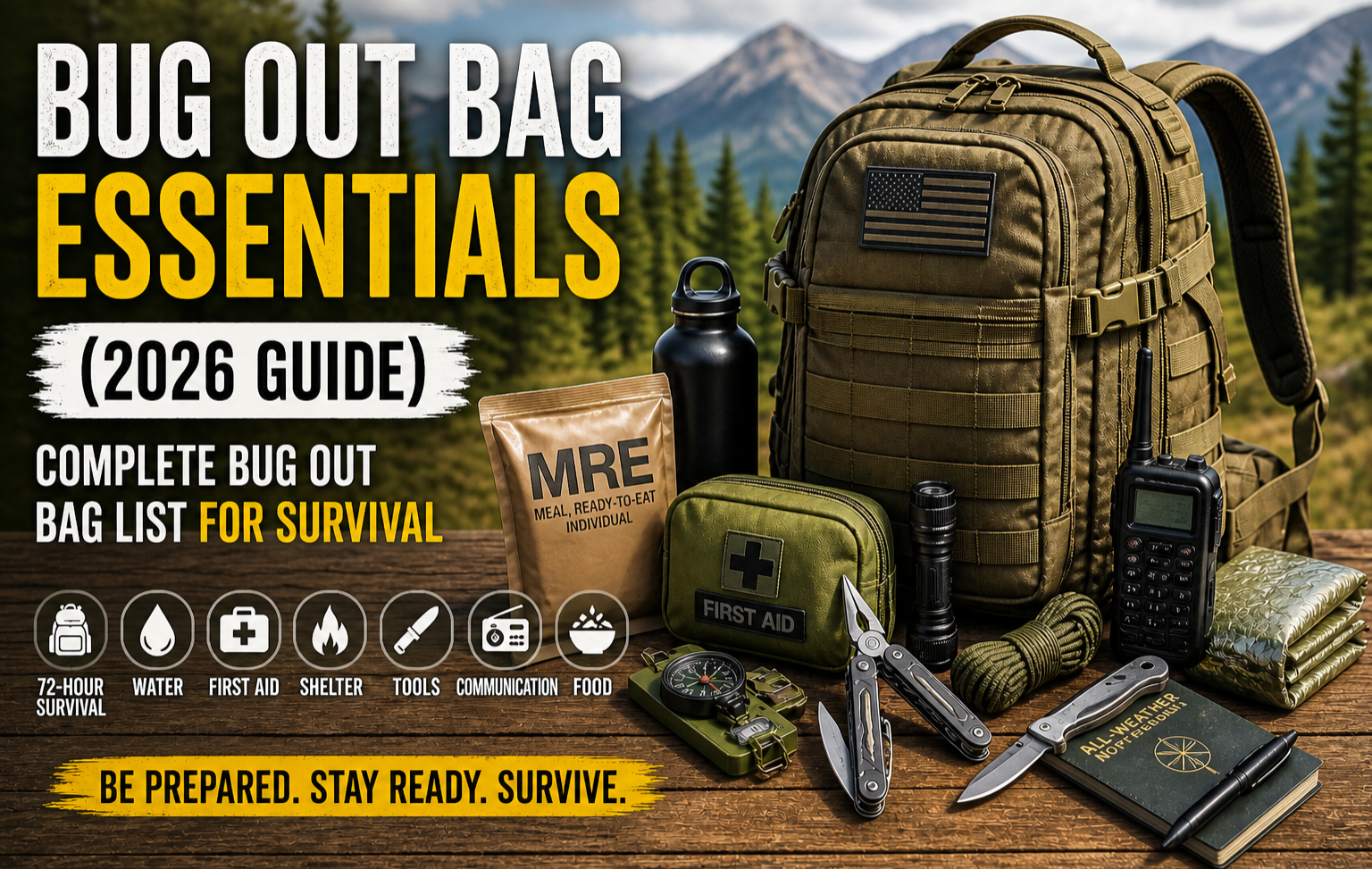
When you find yourself caught in an unforeseen situation—or need to evacuate urgently during an emergency—that is when you truly realize just how important it is to know your bug out bag essentials. This world is incredibly unpredictable; you never know what might happen or when. You might suddenly need to evacuate immediately and be prepared to sustain yourself for the next three days—or even longer.
In this Bug Out Bag List (2026 Guide), we will cover every essential item you should pack—ranging from basic food and water supplies to tactical gear such as durable backpacks and emergency survival kits—ensuring that you stay one step ahead in any situation.
What is a Bug out bag?
First, let me tell those who don’t have any other ideas about what a bug-out bag is. Simply put, these are pre-packed survival backpacks that are very useful in emergency situations and can help you survive for at least 72 hours.
And that’s why these bags are also called “72-Hour Survival Kits.”
While they are mostly used by military personnel and disaster response teams, these days they are becoming increasingly popular among ordinary people as well.
Why everyone should have a Bug Out Bag in 2026?
In 2026, one thing is quite clear: “Only the prepared survive emergencies, and the rest just panic.” And then everyone thinks, “Wish they could also have done something that helps with emergency preparedness.”
In fact, looking at recent years:
- Natural disasters have increased significantly—ranging from floods and earthquakes to devastating storms.
- Global instability is also on the rise.
- Power outages and supply chain disruptions are becoming increasingly frequent.
- And perhaps the greatest threat—one that is currently unfolding and remains a distinct possibility for the future—is war; in such scenarios, essential “bug-out bags” become absolutely indispensable.
Also Read: What you should know about Emergency Preparedness Kits?
It is precisely in these situations that you truly come to understand why you need to own a Bug-Out Bag.
These bags provide crucial assistance in numerous ways during emergencies:
- They help reduce stress and enable you to handle panic-inducing situations with confidence.
- They facilitate rapid decision-making.
- They significantly increase your chances of survival.
Bug Out Bag Essentials (Must-Have Items)
Here are several essential items that most experts believe you must, at the very least, include in your bug-out bag list. Let’s check those:
1. Water & Hydration
Your body can survive without food for up to three weeks, but without water, it can last only three days—especially when you are caught in an emergency situation. When your body is under such stress, dehydration sets in even more quickly. Therefore, the most critical priority for survival is to keep yourself hydrated and ensure a steady water supply to your body. Experts suggest consuming at least 1 gallon of water per day; however, carrying such a heavy load of water—enough to last three days—is simply not feasible.
Instead, a smarter approach is to carry 1–2 liters of water in a durable steel bottle and focus on safely refilling it when needed.
Check out this stainless steel bottle for reliable use
This is where a portable water filter and purification tablets prove invaluable. Rather than relying solely on the water you are carrying, you can use nearby water sources—such as rivers and streams—and treat them to make them safe to drink.
2. Food and Nutrition
When discussing essential items for a bug-out bag, it is crucial that three specific criteria are met.
- The first is “calorie density“—that is, food that provides sufficient energy in the absolute minimum quantity, allowing you to remain fueled without the burden of carrying an excessive amount of food.
- It should be lightweight without adding extra burden to carry, and help you move easily during emergencies
- And the last is one that needs no cooking and minimal preparation, which can be eaten without cooking, fire, or extra efforts, so you can have it in any situation
3. Shelter and Warmth
Most people overlook shelter when packing their bug out bag essentials. They assume they will reach a hotel, stay with relatives, or find an official shelter; however, this is not always the case. This assumption has failed many times during real-life disasters. You should, therefore, be prepared to spend at least one night fully exposed to the elements outdoors.
Exposure to the elements can be just as dangerous as dehydration. Your shelter system doesn’t need to be a full-sized tent; it can be as simple as a durable emergency bivvy or a lightweight tarp paired with a paracord
4. First Aid and Hygiene
It is quite common to sustain injuries during an evacuation or whenever you find yourself in an emergency situation—injuries such as cuts, sprains, and blisters. However, these must be treated promptly to prevent further complications or infections. This is precisely why carrying a first-aid and medical kit is one of the most essential components of your bug-out bag.
5. Fire and Light
Both fire and light are absolutely essential—especially if you find yourself stranded in an emergency for an extended period, such as two or three days. While daylight suffices during the day, it is at night that your greatest need will be for illumination—something you can obtain either from a fire or from a light source.
So, the recommendation is to always carry a headlamp in your bug out bag essentials —along with something that can help you start a fire.
Check this 1100-lumen PETZL Swift RL Headlamp for night survival
Click Here to buy this Headlamp
6. Navigation and Communication
Although everyone nowadays has a smartphone for navigation and communication, these devices have limited battery life; furthermore, signal coverage can be lost, or power can run out sometimes—yet navigation remains absolutely essential. This is precisely why you must always carry a backup tool to assist you in such situations and ensure your safety.
7. Tools and Self Defense
Whenever you find yourself stuck in an unexpected situation, various tools prove to be incredibly helpful—and indeed, you absolutely should have them on hand—because some tools can solve problems that you simply cannot resolve on your own. These tools serve a multitude of practical purposes, such as creating shelter, signaling for help, making repairs, self-defense, and tying things together using rope or paracord.
View the Tactical Survival Kit for all-in-one emergency tools and survival readiness.
Choosing the right bug out bag backpack
The backpack itself is a critical piece of your kit. Look for a bag with a capacity between 40 and 60 liters, as this provides enough space without encouraging overpacking. Choose a pack made from durable material like Cordura nylon and ensure it has strong zippers. Comfort is paramount, so a good suspension system with a padded hip belt and adjustable shoulder straps is non-negotiable. A bag that distributes weight properly will allow you to travel farther with less fatigue. We also recommend choosing a backpack in a neutral color like gray, green, or black to avoid drawing unwanted attention.
Check this backpack that perfectly matches all these criteria—take a look
Final thoughts
A bug out bag is not a gear project — it is a commitment. The people who survive large-scale emergencies better than average are not luckier; they are simply more prepared. Every item on this bug out bag list exists because someone, somewhere, needed it and did not have it.
But more importantly, you need to know which specific items might prove useful in an emergency—what their functions and significance are. Furthermore, if there are any other items you feel should be included, you are absolutely free to include them in your bug out bag essentials.

