


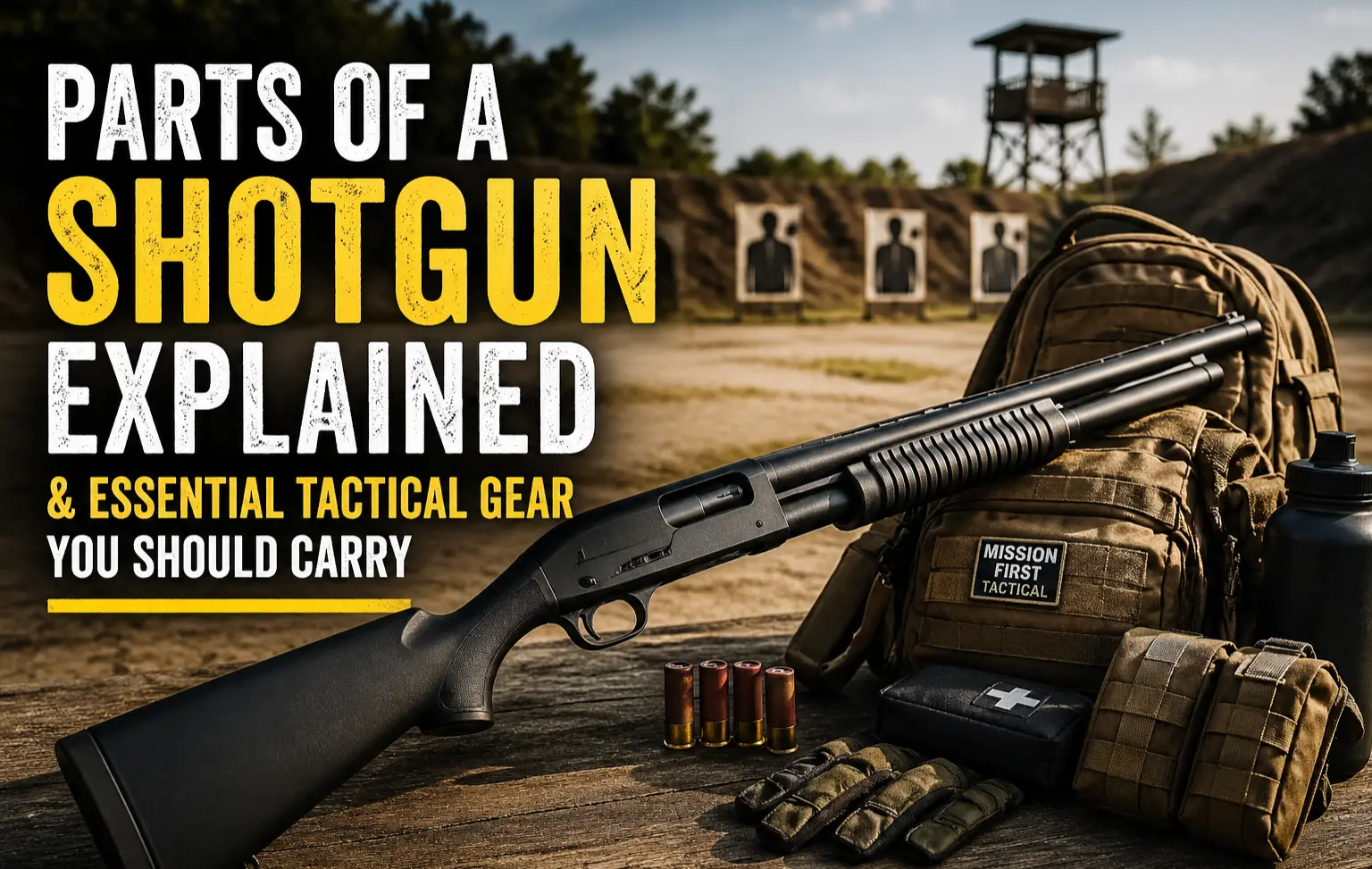
Understanding the parts of a shotgun is just as important as knowing how to point and shoot. If you have ever seen a shotgun—whether in movies, out in the field, at a shooting range, or in a tactical gear video—let me tell you that it’s not just a weapon; it is a system.
The problem is that people often look at a shotgun without understanding its individual components or how it functions within a real-world tactical setup. However, it is actually vital to be familiar with every single part of a shotgun and its specific function and along with that, we’ll also discuss the most essential tactical gear, such as the tactical backpack, MOLLE attachments, tactical holsters, and survival kits that you should carry.
The Real Truth is:
“Understanding the Weapon is half knowledge, the real game is understanding its setup.”
What Are the Parts of a Shotgun?
The shotguns you utilize during missions or tactical operations are composed of numerous components, each serving a specific role; collectively, these components are referred to as the “parts of a shotgun.” The basic—and most critical—parts are:
- Barrel
- Stock
- Trigger
- Magazine Tube
- Receiver
Combining all these makes a functional system for the shotguns, and if you’re a beginner, the basic understanding of these parts is enough to give you clarity.
Key Parts of a Shotgun Explained (Beginner Friendly)
To understand how this shotgun works, you need to understand its parts in some detail. Let’s examine it in detail, using the simplest possible language, to make it easy for you to grasp.
1. Barrel
The barrel is the part of a shotgun from which the bullet or shot is discharged. It is a metal tube through which the projectile travels when fired, and its length depends on the intended use of the shotgun.
2. Stock
The stock is the rearmost part of the shotgun, which you press into your shoulder to absorb recoil and aim steadily. This component rests against your shoulder, providing you with stability. The better the stock, the greater the control while using the shotgun in the real world.
3. Trigger
The trigger is the component of a shotgun that controls the firing mechanism. Pulling it initiates the actual firing of the weapon when the shell is fired. It is not as simple as it might seem to you, because this is, in fact, a major factor regarding safety and control.
4. Magazine Tube
Without a magazine pouch, your shotgun is likely useless. It is one of the most important parts of a shotgun, as it stores the shells—or, as you might also call them, the weapon’s bullets. Its capacity depends on the specific design of your gun; every gun model features its own distinct magazine tube.
5. Receiver
You can also refer to the receiver as the “heart of the shotgun,” as it serves as the connectivity mechanism for all the shotgun’s parts. It’s a metal frame that connects the stock, barrel, and magazine tube. Inside, you’ll find the trigger group.
Why Understanding Parts of a Shotgun Matters
While knowing the names of a shotgun’s parts is essential, understanding their specific functionalities is the most valuable asset—something that proves immensely useful whenever you are using the weapon. To put it in even simpler terms: when you know exactly what the safety, trigger, barrel, and magazine tube are, and understand their specific roles, you will be able to utilize the shotgun far more effectively.
A proper understanding of the components of the shotgun ensures:
- Better Handling
- Safety Awareness
- Real-World Readiness
Shop these Tactical Backpack Now
Essential Tactical Gear You Should Carry
Let’s now take a look at the other essential tactical gear you should carry—the items that complete your setup.
1. Tactical Backpack
Choosing the best tactical backpack is extremely important, and quite often, the success of operations depends on it. It is within these backpacks that you organize your essential gear setup and carry the items that will prove useful during a mission—whether for use at the range or in various outdoor scenarios.
However, to ensure you choose the best tactical backpack, please consider the following factors before making a purchase:
- First is the material durability, ensuring the backpack lasts for a long time.
- Next are the storage compartments, allowing you to carry everything you need.
- And finally, the modular design—enabling you to customize the backpack exactly as you wish.
Check this backpack once: https://www.popsmokemedia.com/products/5-11-rush-24-2-0-tactical-molle-backpacks
2. Backpack MOLLE Attachments
Backpack MOLLE attachments are extremely useful, allowing you to create a customized setup; furthermore, they eliminate any concerns regarding how to carry the gear required for your mission.
Let me outline some of its key benefits that makes it one of the essential tactical gear you should carry:
- Quick access to gears
- Expandible Storage
- Mission-ready setup
It is precisely these features that make this system far more useful—and a superior tactical choice—compared to a normal backpack.
Also Read: Normal Backpack vs Tactical Backpack
3. Tactical Holster (Safety + Accessibility)
Holsters are typically made of leather and are designed to hold your handguns or weapons. They are considered an essential piece of tactical gear because a good holster is non-negotiable.
Why are they so important?
- Ensure Safety
- Easy and quick accessibility to the gun
- Comfort while carrying; the holster design should be such that it remains concealed and comfortable even when worn.
Check this Holster Once: Glock 19 IWB Holster
4. Utility / Hydration Gear
For a long mission, it is crucial to stay hydrated and energized; to achieve this, the best and most important step is to carry hydration gear. Therefore, a simple water bottle—or hydration gear attached to your tactical backpack—ensures that you remain active, alert, hydrated, and ready to act under any conditions.
Common Mistakes Beginners Make
Many newcomers or those who simply don’t know how to buy and set up actual gear repeat some common mistakes:-
- The first one is overloading gear with unnecessary accessories that only add weight and complexity without adding any benefit.
- The next mistake they make is buying cheap and unreliable gear, such as specialty optics and lights that can’t handle a shotgun’s recoil.
- Finally, the most critical error is focusing too much on gear and not enough on training. The best tactical gear in the world is useless without the skill to run the weapon and perform reloads under pressure.
Final Thoughts
Through this short blog, one thing must have become clear to you: understanding the parts of a shotgun is just as important as choosing the perfect weapon. When you know the specific purpose of each part or component of a weapon, operating it perfectly becomes even easier.
You should always adopt a practical approach—for instance, by acquiring a tactical backpack from a reliable, top-tier brand, making smart use of the backpack MOLLE attachments, and utilizing a dependable “Mission First Tactical” holster that facilitates concealed carry while ensuring easy access to your handgun. If you successfully implement all of these steps, your gear becomes truly “real-world ready.”

