


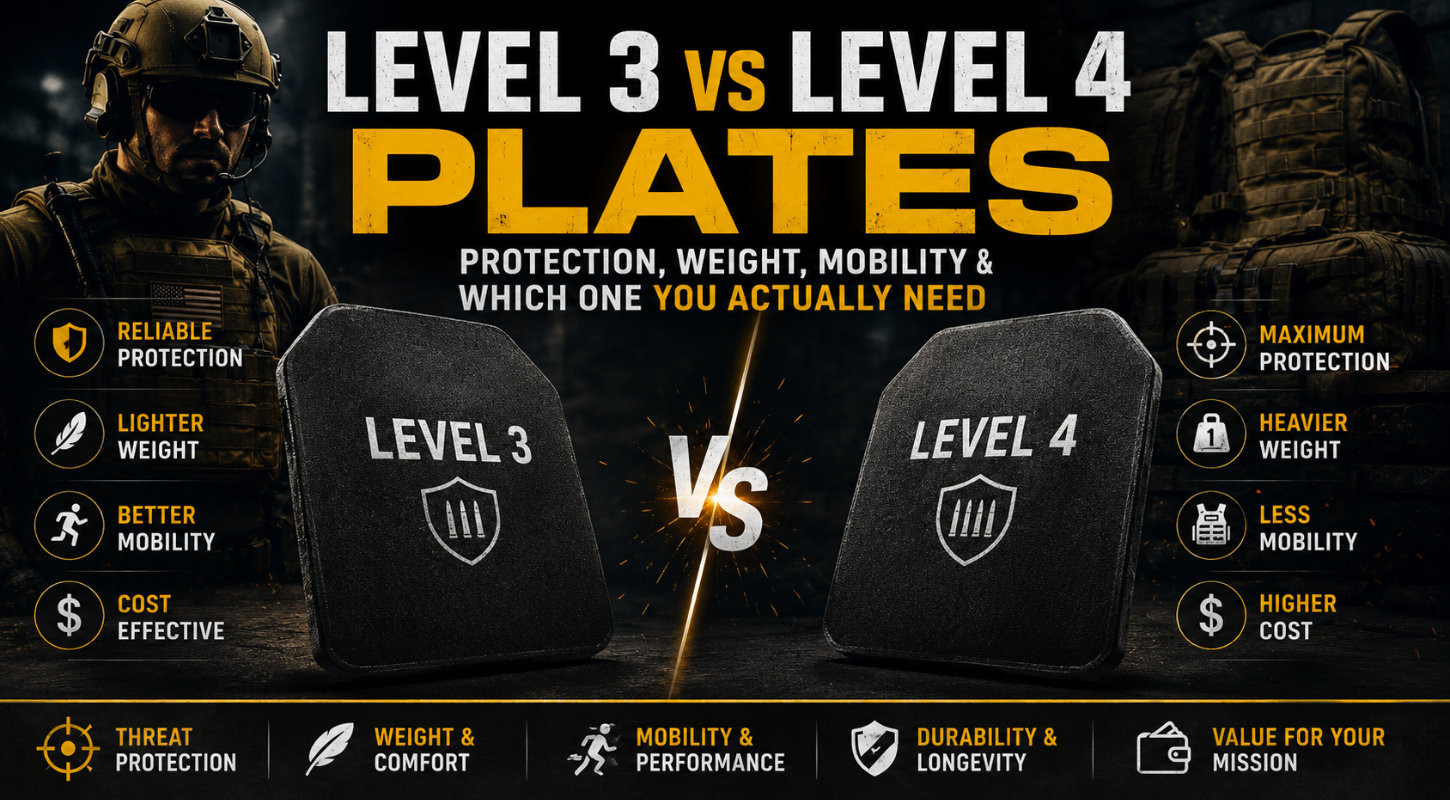
If you’re shopping for body armor plates, you’ve probably hit the same wall most people hit: Level 3 or Level 4?
One common perception that obviously comes to mind is —higher numbers means better protection. Isn’t it what you’ve also thought? But to be honest, that’s not the whole story. Picking the wrong plate for your use case only means you’re carrying unnecessary weight, reduced mobility, or — worse — inadequate protection for the specific threats you actually face.
This guide cuts through the marketing noise. Whether you’re a law enforcement officer, a competitive shooter, a prepper, or a civilian preparing for worst-case scenarios, you’ll walk away knowing exactly which plate belongs in your carrier.
What Are Level 3 Plates?
Level 3 body armor plates are designed to offer protection against common rifle threats.
Polyethylene (PE/UHMWPE): Ultra-high-molecular-weight polyethylene plates are the lightest Level 3 option on the market. A full-size 10×12 plate typically weighs between 3 and 4 pounds. The trade-off is thickness — PE plates tend to be bulkier than ceramic alternatives.
Ceramic Composite: Ceramic-faced plates with a PE backing offer a balance of weight and multi-hit capability. These typically weigh between 5 and 7 pounds per plate, depending on manufacturer and cut.
Steel: Steel Level 3 plates are the heaviest option (often 8+ pounds per plate) and the cheapest. They’re durable but come with significant spall concerns — bullet fragmentation that can injure exposed areas. Most serious buyers avoid bare steel without anti-spall coatings.
What Level 3 Plates Stop
A properly certified Level 3 plate will handle:
- 5.56×45mm NATO (M193, M855)
- 7.62×39mm (standard AK rounds, including mild steel core variants on many plates)
- 7.62×51mm NATO (.308 Winchester ball)
- 9mm, .44 Magnum, .357 SIG, and virtually all common handgun rounds
What standard Level 3 plates may NOT stop: M855A1 (green tip enhanced), M193 at close range on some plates, M855 at close range (depending on plate design), and any AP (armor-piercing) variants. This is where the concept of Level 3+ comes in — a non-NIJ-official designation that manufacturers use to indicate plates tested against M855 and similar enhanced threats, but not the full AP spec required for Level 4.
Typical Level 3 Plate Weight
| Plate Type | Approximate Weight (10×12 plate) |
|---|---|
| UHMWPE (standalone) | 3.0 – 4.5 lbs |
| Ceramic/PE composite | 5.0 – 7.0 lbs |
| Steel (with coating) | 7.5 – 9.0 lbs |
What Are Level 4 Plates?
Level 4 plates — NIJ Level IV — are the highest rating in the NIJ 0101.06 body armor standard. They must defeat at least one round of .30 caliber armor-piercing (AP) ammunition (M2 AP) traveling at approximately 2,880 feet per second.
Read this Complete Guide: Level 4 Plates Explained
That single phrase — “armor-piercing” — is what separates Level 3 from Level 4. These plates are designed to handle the hardest-hitting, reduce their energy force, and penetration-optimized rifle rounds that Level 3 plates can struggle with.
What Level 3 Plates Are Made Of
Level 4 plates are almost exclusively ceramic composite. The ceramic material fractures on impact, dissipating the bullet’s energy before it can penetrate. A PE backer catches the fragments. Some premium plates use silicon carbide or boron carbide ceramics for better multi-hit performance.
You will not find legitimate standalone polyethylene Level 4 plates. PE simply cannot meet the AP testing requirement. Be very skeptical of any product claiming Level IV polyethylene construction.
What Level 4 Plates Stop
Level 4 plates are rated to handle:
- .30-06 M2 AP (the NIJ test round)
- 7.62×54mmR (the standard Russian/Soviet rifle round used in Dragunov and PKM platforms)
- 5.56mm M855A1 (Enhanced Performance Round — this stumps many Level 3 plates)
- .308 AP variants
- All threats Level 3 plates stop
Important caveat: Level 4 plates are rated for one hit from an AP round at the NIJ test standard. Multi-hit performance from AP ammunition is not part of the NIJ IV certification. Most quality Level 4 plates will survive multiple hits from non-AP rifle rounds, but manufacturers’ specs vary significantly.
Typical Level 4 Plate Weight
| Plate Type | Approximate Weight (10×12 plate) |
|---|---|
| Ceramic/PE composite (standard) | 6.5 – 8.5 lbs |
| Advanced ceramic (SiC/B4C) | 5.5 – 7.5 lbs |
| Budget ceramic (alumina) | 7.5 – 9.5 lbs |
Level 3 vs Level 4 Plates: Key Differences at a Glance
| Factor | Level 3 Plates | Level 4 Plates |
|---|---|---|
| NIJ Rating | NIJ III (0101.06) | NIJ IV (0101.06) |
| Test Round | 7.62×51mm NATO M80 ball | .30 cal M2 AP |
| AP Protection | No (without Level 3+ designation) | Yes |
| M855A1 Protection | Varies (Level 3+ typically yes) | Yes |
| Min. Weight (10×12) | ~3.0 lbs (PE standalone) | ~5.5 lbs |
| Typical Weight (10×12) | 4 – 6 lbs | 7 – 8.5 lbs |
| Multi-hit Capability | Generally strong | AP: limited; rifle: solid |
| Mobility | Higher | Lower |
| Heat Tolerance | PE: poor in high heat | Better than PE |
| Price Range | $150 – $500 per plate | $200 – $800 per plate |
| Best Use Case | Law enforcement, civilians, shooters | Military, high-threat, AP environments |
The Weight Reality
This is the number most people underestimate until they’re three hours into a patrol or range session.
A pair of Level 3 PE plates might add 7–8 lbs to your carrier. A pair of standard Level 4 ceramic plates adds 14–17 lbs before you’ve attached a single accessory. Over an 8-hour shift or a 10-mile ruck, that difference becomes deeply personal.
Weight is not just about comfort — it directly affects:
- Reaction time — Heavier loads slow lateral movement and draw speed
- Fatigue accumulation — Faster muscle fatigue reduces decision-making quality
- Injury risk — Long-term back and joint stress from sustained heavy loads
The Protection Reality
For most threat environments in the United States — including civilian self-defense and most domestic law enforcement scenarios — Level 3 (or Level 3+) plates cover the realistic threat spectrum. The majority of criminal and active-shooter incidents involve handgun rounds or common rifle calibers that Level 3 plates handle without issue.
Level 4 plates make sense when the threat environment specifically includes AP ammunition, military-grade projectiles, or adversaries likely equipped with armor-defeating rounds — scenarios more common in active military deployments than domestic civilian contexts.
Which Plate Carrier Works Best With Level 3 and Level 4 Plates?
Your plate is only as good as the carrier holding it in position. The best plate in the world provides zero protection if it’s shifting around or sitting in the wrong position on your torso.
Check this Guide to choose the Best Plate Carrier of 2026
Key Plate Carrier Considerations
Plate Compatibility: Check the plate carrier’s pocket dimensions against your plate’s actual dimensions. Plates are sized by cut (SAPI, swimmer, shooter, square) as much as by nominal size. A 10×12 shooter-cut plate sits very differently in a carrier sized for a standard 10×12 than you might expect.
Cummerbund Design: For Level 4 plates, a robust cummerbund is critical. The additional plate weight creates more torque on the carrier, and a flimsy cummerbund will sag, shift, and eventually fail its job of keeping the side panels positioned correctly.
Adjustability: For law enforcement officers who wear their carrier for 8–12 hour shifts, micro-adjustability at shoulder straps and cummerbund is worth every extra dollar. Fit directly affects both comfort and plate placement — and plate placement affects protection.
Recommended Carrier Pairings
For Level 3 Plates (especially lightweight PE):
- Spiritus Systems LV-119 / LV-CORE — Minimalist overt and covert options, excellent for lightweight PE plates. Ideal for civilian daily carry or plainclothes applications.
- Ferro Concepts ADAPT — Extremely adjustable, MOLLE-heavy, good for shooters who run accessories.
- Velocity Systems SCARAB — Mid-weight, excellent build quality, pairs well with both PE and ceramic Level 3 plates.
For Level 4 Plates:
- Crye Precision JPC 2.0 — One of the most proven carriers for heavier ceramic plates. The padded shoulder straps and structured cummerbund distribute Level 4 weight well.
- Shellback Tactical Banshee Elite — Budget-friendly option with genuine structural support for heavier plates. Good entry point for Level 4 users.
- Mayflower / Velocity Systems UW Gen IV — Excellent for extended wear with heavy ceramic, particularly for law enforcement and military applications.
- FirstSpear Strandhogg — Premium carrier with modular cummerbund system, one of the best options for extended heavy-plate wear.
Have a Look at this Plate Carrier:
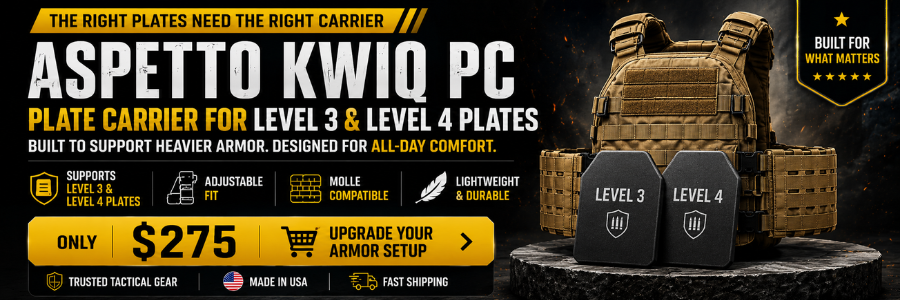
https://www.popsmokemedia.com/products/aspetto-kwiq-pc-2-plate-carrier-body-armor
What to Avoid
Avoid ultra-minimalist “slick” carriers with thin single-layer nylon construction when running Level 4 plates. They work fine for Level 3 PE, but the additional stress of Level 4 ceramics accelerates wear and can compromise the carrier’s structural integrity over time.
Common Buying Mistakes to Avoid
Understanding the specs is half the battle. The other half is not making one of these avoidable mistakes:
1. Buying Non-NIJ Certified Plates
This is the most dangerous mistake. The NIJ certification process is independent third-party testing. “NIJ-compliant” or “NIJ-standard” listed on a product page means nothing if the plate hasn’t been independently tested and is listed in the NIJ’s Compliant Products List (CPL). Always verify certification at nij.ojp.gov.
Counterfeit and substandard plates — particularly those sold on overseas e-commerce platforms — routinely fail when tested. The price savings are not worth the consequence.
2. Ignoring the Level 3+ Category
Many buyers frame the decision as strictly Level 3 vs Level 4, unaware that Level 3+ plates exist in a meaningful middle ground. Level 3+ plates (not an official NIJ designation, but increasingly standardized by manufacturers) are tested against M855 and sometimes M855A1 in addition to the standard Level 3 threats. If your threat assessment includes green-tip 5.56 but you’re not specifically concerned about .30 AP, Level 3+ may be the optimal choice — lighter than Level 4, broader protection than standard Level 3.
3. Choosing Plate Size Incorrectly
Most adults in the 5’8″–6’1″ height range with average torso width use a 10×12 plate. The plate should cover the vital zone — roughly from below the clavicle to above the navel, and covering the cardiac area laterally. Going too large creates mobility restriction; going too small leaves vital anatomy exposed. When in doubt, consult a plate sizing guide from your carrier manufacturer and measure your own torso.
4. Treating Multi-Hit Specs as Absolute
Manufacturers test plates under controlled conditions. Real-world multiple impacts — especially on the same strike face zone — perform differently. Two AP rounds through the same point on a Level 4 plate will almost certainly defeat it. Plan protection strategy accordingly: multiple threats require movement, not static reliance on rated plate performance.
5. Neglecting Trauma Pads / Backers
Even plates that stop penetration create significant blunt trauma on the body. Trauma pads placed behind the plate dramatically reduce this force. For extended duty wear or high-risk applications, a Level IIIA soft armor backer behind a hard plate provides both additional protection at the plate’s edges and meaningful trauma mitigation.
6. Buying Based Solely on Price
With body armor, the budget end of the market is full of plates that technically claim certification but cut corners in materials or manufacturing consistency. Spend the money. Your torso is not the place for value engineering.
Shop the Field Related Gears at Popsmokemedia
Who Should Choose Level 3 Plates?
Level 3 — especially Level 3+ — is the right call for the majority of buyers. Here’s who fits that profile:
Law Enforcement Officers (Patrol / Plainclothes)
Patrol officers face a daily threat environment dominated by handguns and common rifle calibers. Level 3 plates — particularly lightweight PE options — allow 8–12 hour shifts without the physical toll of Level 4. When threat intelligence doesn’t indicate AP-equipped adversaries, Level 3+ is the professional standard.
Competitive and Tactical Shooters
If you’re running a plate carrier for 3-Gun, competition shooting, or force-on-force training, Level 3 is the obvious choice. The weight savings translate directly to performance. You’re not taking live fire; you’re training to move efficiently under simulated load.
Prepared Civilians (Home Defense, SHTF Prep)
The realistic domestic threat for a civilian — home intrusion, civil unrest, active shooter situation — does not involve AP ammunition. Level 3 plates cover that threat envelope adequately. Lightweight PE plates in a minimalist carrier are practical to store, quick to don, and protective against every realistic threat scenario a civilian is likely to face.
Hunters and Backcountry Users
Some hunters and backcountry guides in areas with elevated bear or human threat concerns have begun carrying soft or hard armor. For this use case, Level 3 PE’s weight advantage is decisive — you’re already carrying a pack, a rifle, and emergency supplies.
Budget-Conscious Buyers Who Need Real Protection
If budget is a constraint, a quality Level 3 plate from a reputable manufacturer (AR500 Armor, Spartan Armor Systems, RMA Armament, LTC) provides meaningful protection at a more accessible price point than Level 4 ceramics from equivalent-quality manufacturers.
Who Should Choose Level 4 Plates?
Level 4 plates serve a narrower but clearly defined population:
Active Military (Combat Deployments)
This is the primary use case Level 4 plates were designed for. Military engagements — particularly against state or near-peer adversaries — involve the genuine possibility of encountering AP ammunition, military-surplus weapons, and heavy rifle platforms. For deployed personnel, the weight penalty of Level 4 is accepted because the threat environment demands it.
High-Risk Law Enforcement Operations
SWAT, tactical entry teams, and hostage rescue units face threat environments fundamentally different from patrol. When a search warrant execution might involve a suspect known to possess AP-capable weapons, Level 4 makes operational sense. Many tactical units maintain separate plate loadouts — lighter Level 3 for standard operations, Level 4 for elevated-threat missions.
Personnel in Active Conflict Zones
Journalists, contractors, security personnel, and NGO workers operating in regions where military-grade weapons are common should default to Level 4 if logistics allow. The threat envelope in conflict zones includes crew-served weapons, SVD Dragunov platforms, PKM variants, and AP surplus ammunition widely available in post-conflict arms markets.
Buyers in Specific High-AP-Risk Environments
Certain domestic high-risk contexts — rural areas with specific organized crime threats, personnel involved in high-value asset protection — may justify Level 4 after genuine threat assessment. This is not a marketing consideration; it’s a mission analysis decision.
Which One Actually Should You Buy?
One of the biggest confusion after Level 3 vs Level 4 Plates and choosing the best between the both is how to find which one is actually perfect for you. Here’s the honest answer most guides won’t give you:
For most civilians, most law enforcement patrol officers, and most preppers — Level 3+ is the correct answer.
Standard Level 3 leaves a gap with M855 green-tip, which is one of the most common rifle rounds in circulation. Level 3+ closes that gap. Level 4 adds weight and cost to defend against a threat — AP ammunition — that most buyers will statistically never face.
Buy Level 4 if:
- You are actively deployed or will be operating in a conflict zone
- Your mission intelligence specifically indicates AP-capable threats
- You are part of a tactical entry team with known elevated threat profiles
- You are willing and able to manage the weight over sustained operations
Buy Level 3+ if:
- You are a law enforcement patrol officer
- You are a prepared civilian
- You are a competitive shooter or trainer
- You want the widest coverage for common domestic rifle threats without the Level 4 weight penalty
Buy standard Level 3 if:
- Budget is a hard constraint and Level 3+ is out of reach
- You are primarily concerned with handgun and common rifle threats
- You prioritize mobility above all else and your threat assessment supports it
Key buying checklist regardless of level:
- Verify NIJ certification on the official CPL
- Buy from established US manufacturers (RMA, Hesco, ShotStop, AR500 Armor with coatings, Highcom, LTC)
- Match your plate cut to your carrier
- Size correctly for your torso
- Add trauma pads behind your plates
- Inspect plates annually for damage (especially ceramics — internal fractures are invisible externally)
Conclusion
The Level 3 vs Level 4 plates debate is ultimately a threat assessment exercise, not a spec sheet comparison.
Level 4 plates are the most protective hard armor available to the civilian and professional market. They handle AP rounds. They meet the highest NIJ standard. For the right use case — active military deployment, high-risk tactical operations, conflict zone environments — they are the correct choice, and the weight is the price of doing business.
But for the vast majority of buyers — patrol officers, prepared civilians, trainers, and shooters — Level 3+ plates provide coverage against every realistic threat while keeping you mobile, less fatigued, and more operationally effective over sustained wear.
Buy what your actual threat environment demands. Verify your certification. Invest in a quality carrier that fits the plate’s weight and cut. Train with the load you plan to wear.
The best plate is the one that’s calibrated to your real-world risk — not the one with the highest number.

