


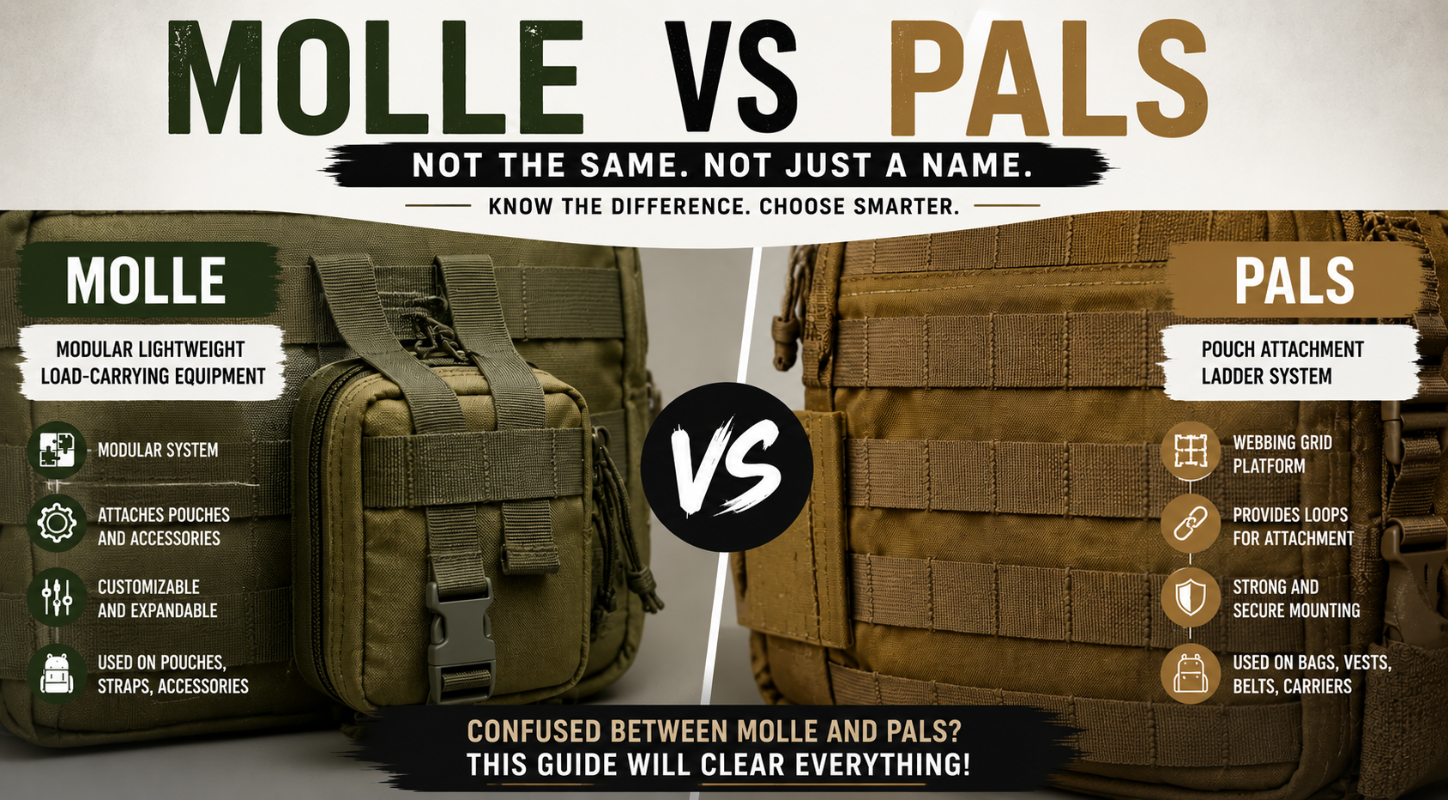
If you’ve ever searched for tactical backpacks, military gear, plate carriers, or outdoor loadout systems, you’ve probably come across the terms MOLLE and PALS. Many people use these terms interchangeably, but they are not actually the same thing. Therefore, it’s important to understand the difference between MOLLE vs PALS webbing.
The confusion arises because the terms are frequently used together, but they refer to two distinct parts of a single, brilliant system for carrying gear. Getting this distinction right is key to building a reliable and modular equipment setup.
Before understanding the difference between the MOLLE vs PALS, you must be clear with what exactly they mean. Let’s see their meaning first.
What Is MOLLE Webbing?
MOLLE is an acronym that stands for Modular Lightweight Load-carrying Equipment. This system allows users to attach different additional pouches, accessories, tools, and gears to your backpacks, plate carriers, vests, and other tactical gear items.
Check this MOLLE military tactical backpack: 5.11 MOLLE Webbing backpack
The primary goal of the MOLLE system is to provide users with complete control over how they organize and carry their equipment with the Customization feature. Instead of having fixed pockets, users can add, remove, or reposition pouches based on their immediate needs. This adaptability makes it highly practical for a wide range of applications, from military operations to weekend camping trips. The system itself includes the base platform (like a vest), the attachable pouches, and the method used to connect them.
For example, you can attach:
- Magazine pouches
- Medical kits
- Utility pouches
- Dump pouches
- Flashlight holders
Read this for Detailed Understanding: What is MOLLE?
What Is PALS Webbing?
PALS is the specific component that makes the MOLLE system work. The acronym stands for Pouch Attachment Ladder System. PALS is the grid of heavy-duty nylon webbing that is stitched onto backpacks, vests, and other gear. This grid is the physical foundation that allows for the attachment of MOLLE-compatible accessories. You can easily recognize it by its horizontal rows of webbing spaced one inch apart.
The design of PALS is precise and standardized to ensure universal compatibility. The webbing strips are one inch wide and are stitched to the backing material at 1.5-inch intervals. This “ladder” of loops creates a stable and secure platform. Any pouch designed for the MOLLE system will have vertical straps on its back that are meant to be woven through these PALS loops, creating a tight and reliable connection.
MOLLE vs PALS: Main Differences
This is where most people get confused.
Although they work together, MOLLE and PALS are not identical.
| Feature | MOLLE | PALS |
|---|---|---|
| Full Form | Modular Lightweight Load-carrying Equipment | Pouch Attachment Ladder System |
| What It Is | A modular attachment system | A webbing grid/platform |
| Main Purpose | Helps attach and organize gear | Provides loops for attachments |
| Physical or Functional? | Functional carrying system | Physical stitched webbing |
| How It Works | Uses straps/snaps to secure pouches | Allows MOLLE straps to weave through loops |
| Commonly Found On | Pouches, accessories, detachable gear | Backpacks, vests, belts, plate carriers |
| Main Advantage | Customization and expandability | Stability and secure mounting |
| Can It Work Alone? | Usually requires PALS webbing | Yes, webbing can exist without MOLLE pouches |
| Biggest Difference | MOLLE is the attachment system | PALS is the actual webbing structure |
The easiest way to understand it is this:
Think of PALS as the “foundation” and MOLLE as the “system” that uses that foundation.
In simple words:
- PALS = the webbing platform
- MOLLE = the attachment system
Without PALS webbing, MOLLE attachments would not work properly.
How Molle And Pals Work Together
The connection between a MOLLE pouch and a PALS platform is secure because of a specific weaving technique. The pouch has one or more vertical straps on the back, often stiffened for easier use. To attach it, you slide the strap down through the first PALS loop on the vest or bag. Then, you weave the strap back through the first loop on the back of the pouch itself.
This process is repeated, alternating between the PALS grid on the platform and the webbing on the pouch, until the entire strap is woven through. The end of the strap is then secured, usually with a sturdy snap closure or a tuck-tab design. This interwoven connection distributes weight and stress across multiple points, preventing the pouch from bouncing, sagging, or tearing off during movement. This stability is a key feature of the system’s design.
Check this guide to know: How to use MOLLE pouches on a backpack?
Benefits Of MOLLE & PALS System
Benefits of MOLLE
- Highly modular system that allows full gear customization.
- Loadout can be changed quickly for different situations and roles.
- Supports attachment of various utility pouches and accessories.
- Widely used beyond military applications like hiking and photography.
- Improves functionality by letting users organize gear efficiently.
Benefits of PALS
- Provides a secure and stable attachment for pouches.
- Prevents gear shifting during movement or physical activity.
- Reduces noise compared to older clip-based systems.
- Increases comfort through better load stability.
- Ensures compatibility between gear from different manufacturers.
MOLLE vs PALS: Use Cases
Knowing the difference between MOLLE vs PALS becomes very easy and the decision even easier when you know their use cases, when that particular system is used and where.
MOLLE Use Cases
- Used to customize tactical vests and backpacks.
- Ideal for military, law enforcement, and emergency response setups.
- Helps users organize gear according to specific missions or activities.
- Commonly used in EDC (Everyday Carry) bags and vehicle kits.
- Suitable for attaching mission-specific pouches and accessories.
PALS Use Cases
- Provides the webbing platform for attaching MOLLE-compatible gear.
- Commonly found on backpacks, vests, and tactical belts.
- Used by hikers and campers to carry external equipment.
- Allows quick access to tools, medical kits, and hydration carriers.
- Helps expand storage capacity without opening the main compartment.
Things To Check Before Buying Molle/Pals Gear
When purchasing equipment that uses this system, there are a few quality indicators to look for. These details ensure the gear will perform reliably and last a long time.
Stitching Quality
Look for bar-tack stitching at the stress points. A bar-tack is a series of dense stitches that reinforce areas where the webbing is attached to the base fabric. This type of reinforcement is critical for preventing the webbing from tearing away under a heavy load. Consistent and clean stitching throughout the grid is also a sign of good manufacturing.
Standardized Spacing
Ensure the webbing follows the official PALS specification: one-inch-wide webbing strips, spaced one inch apart vertically, with attachment stitches every 1.5 inches horizontally. Gear that does not follow this standard may not be compatible with other MOLLE accessories. Non-standard spacing can make it difficult or impossible to properly weave and secure pouches.
Material and Modern Alternatives
Traditional PALS is made from durable nylon webbing. High-quality gear often uses materials like 500D or 1000D Cordura fabric for the base platform. A newer trend is laser-cut PALS, where attachment slots are cut directly into a laminated fabric panel. This method reduces weight and creates a lower-profile, snag-free surface while maintaining compatibility with standard MOLLE pouches.
Expert Tips For Using Your Gear
- Always Weave Correctly. The most common mistake is simply passing the strap through the PALS loops without weaving it back through the pouch’s webbing. Proper weaving is essential for a secure fit. Take the extra minute to interlace the straps fully for maximum stability.
- Distribute Weight Evenly. When arranging your pouches, place heavier items closer to your center of gravity and higher up on a backpack. This improves balance and reduces fatigue. Lighter, less frequently used items can be placed on the sides or bottom.
- Perform Regular Checks. Before heading out, inspect your setup. Check that all snaps are secured and that the stitching on high-stress PALS loops is intact. This simple habit can prevent gear loss or failure when you are relying on it the most.
Final Verdict
MOLLE and PALS are closely connected, but they are not the same thing.
- MOLLE is the modular carrying system.
- PALS is the webbing platform that makes the system work.
Understanding the main difference between MOLLE vs PALS helps you make an informed decision and choose better tactical gear avoiding any sort of confusion when buying tactical backpacks, Plate Carrier, Pouches, or any other accessories.
Whether you’re building an outdoor setup, organizing your emergency gear, upgrading your EDC setup, or buying a tactical gear, a good MOLLE/PALS system can offer you great flexibility, durability, and long-term usability.

